

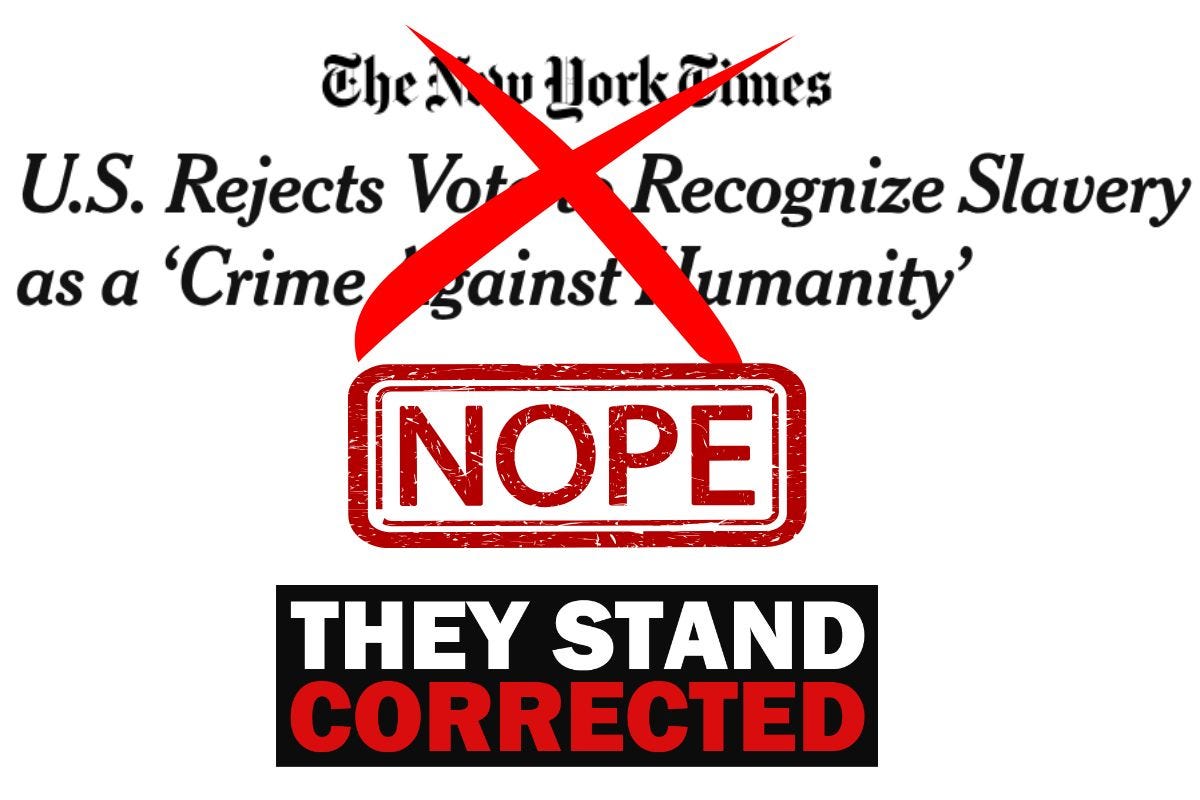
No matter how desperate any news agency is to get you to click, it can never lie or mislead — that is, under the most basic rules of journalism. But Big Media does so all the time anyway.
A new, big example should draw the attention of everyone who cares about the truth and crimes against humanity. It involves one of the most serious topics there is: slavery.
It’s about more than a journalistic fiasco. It may be the biggest sign yet of a damaging, nonsensical thought process that leaves out facts, logic, and reason. This story involves the United Nations, Vikings, the British asking an African nation to stop slavery, and more. I break it down in the new episode. Listen now:
The vote that wasn’t
The other day, the United Nations held an important vote. The New York Times headline about it reads, “U.S. Rejects Vote to Recognize Slavery as a ‘Crime Against Humanity.” That’s a lie. Of course slavery is a crime against humanity. U.S. governments say so all the time.
The subheadline also misleads, and was designed to further the Times’ rage agenda. “Israel and Argentina also voted against it.” Nowhere in the article does the Times tell you what actually happened: All of the European Union and many other democracies including Canada, Australia, New Zealand, and South Korea also refused to vote for this misguided resolution.
Ghana put forward a resolution to declare just the Transatlantic slave trade the gravest crime against humanity — not “a” crime against humanity. Everyone committed to truth and justice knows it makes no sense to rank the many atrocities human inflict on each other. And people have been enslaved by multiple empires for millennia.
Understanding this does not take anything away from the horror of the Transatlantic slave trade and its fundamental role in building America. It refuses to let giant swaths of the world built on slavery hide in the shadows of selective memory.
Dozens of countries made clear they oppose this resolution. They didn’t have the guts to vote against it, so they abstained — 52 in all. But in public remarks, leaders stated their opposition.
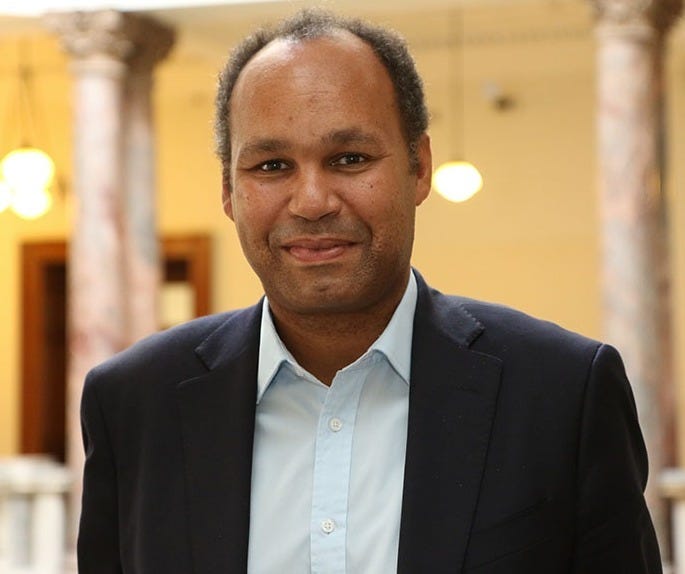
Ambassador James Kariuki, the UK’s deputy permanent representative to the United Nations, explained:
“We must not create a hierarchy of historical atrocities. Doing so simplifies the complexity and vast scale of suffering endured in different contexts. It risks diminishing the experiences of communities whose trauma and suffering was felt just as strongly. No single set of atrocities should be regarded as more or less significant than another.”
Here’s why this example of media failure is so important. Victim narratives are plaguing minds and preventing people from learning facts. In voting for this resolution, more than 100 countries entered and condoned a victimhood Olympics.
The media could have used this to educate people on horrors they’ve never heard of. For example, as the Smithsonian Channel put it, “The Indian Ocean Slave Trade Was Likely Bigger Than the Atlantic Trade.” It was dominated and run by the Arab Islamic empire (an umbrella term for multiple Arab Islamic empires).
In this episode, I also share a clip of historian Raymond Ibrahim on something called the Winston Marshall show. He explains that many Viking raids were designed “to feed the Arab slave emporium.” And a YouTube channel called Al Muqaddimah discusses what happened when the British asked Morocco to stop slavery.
The media virtually always ignores inconvenient history. This entire subject is treated as taboo. But you can find a few, scattered examples of recognition. PBS acknowledged that Arab Muslim conquerors slaughtered Jewish men in Medina and enslaved the women and children.
The New York Times is feeding the false idea that remembering the victims of the Transatlantic slave trade requires officially declaring their enslavement to be worse than that of other people. That’s ridiculous and dangerous. To build a better world, we have to understand the full scope of humanity’s past.
I read the article. As is often the case, the headline is an attention grabber and contradicts the article. The writer, in the first paragraph, states, “The United States voted against a United Nations resolution this week to formally recognize the trans-Atlantic slave trade as the 'gravest crime against humanity’.” Unfortunately, the article is superficial and does not mention other areas of the slave trade or that the EU countries abstained. The writer is the West African bureau chief for the NYT.
Excellent article and frankly, I'm sickened by the activist media and their lies and I don't care if they are rw or lw lies.